
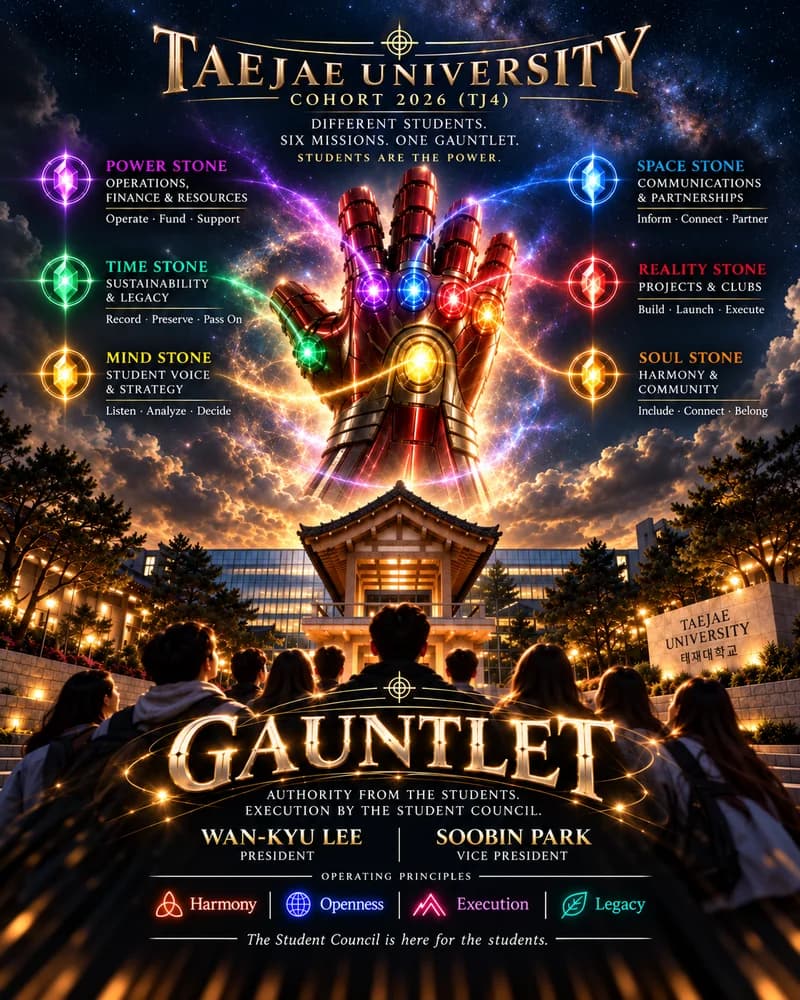
2. WAN-KYU LEE (22)
Running mate: President WAN-KYU LEE · Vice president SOOBIN PARK (24)
“72 Infinity Stones. One Gauntlet. ASSEMBLE.”
21 votes
21 out of 58 votes (36%)
Q. What is the difference between School's English couching sessions and your global student's English couching session?
A. The University’s English coaching is more formal and professor-based, while what we are proposing would be casual, flexible, and peer-based. Instead of another structured lesson, students could practice conversation, ask questions, or get informal feedback from international friends in a relaxed setting. Since the number of international students is relatively small, participation would always be voluntary, and we would coordinate schedules carefully so the program remains realistic and does not place too much pressure on anyone. We would first check actual demand and interest rather than assuming everyone needs one-on-one support. If demand is higher than our Cohort can reasonably handle, we could also explore exchanges with nearby universities and create informal opportunities to use English naturally. Our goal is not to replace the University’s program, but to give students comfortable chances to use English in everyday situations and gradually become more confident with it.
Q. You promised to organize English coaching sessions for students who are not yet comfortable with the language. You mentioned considering one-on-one meetings; however, given that the proportion of international students is low compared to Korean students, is it realistically possible to meet everyone's needs? Have you obtained consent from all the international students involved? If not, are you providing compensation? How do you realistically plan to conduct these sessions?
A. That is a fair concern. We do not expect international students to become unpaid English tutors, and participation should be fully voluntary. What we have in mind is not one-on-one tutoring or another English class, but fun, low-pressure ways for Korean and international students to spend time together—for example, watching the same movie and meeting weekly to discuss it, language exchange, or small-group conversations. RAs and the University can support these efforts, but they cannot create this kind of culture by themselves or remove everyday barriers for us. It cannot be forced, but it also will not happen without effort. Our goal is to gently create more chances for students to become comfortable with one another and gradually feel more confident using English. We would check actual demand, coordinate schedules realistically, and, if needed, explore exchanges with nearby universities.
Q. when 원재 candidate mention how to pick other members of the student council, u mentioned blind interview. Is ur 6 departments were planning to do a blind interview? And how do u think that makes better judgement with getting limited information for the department member?
A. We don’t clearly remember whether we used the phrase “blind interview” during the debate, so we want to clarify our actual plan. Our principle is Open Recruitment + Equal Opportunity + Role Fit + Student Voice, which we had already shared in our Platform Booklet before Chuseok. The process is Recruitment Announcement → Application & Recommendation → Application Review → Individual Interviews → Joint Evaluation → Final Selection → Role Announcement → Onboarding. This may look detailed on paper, but it is meant to make the process fair and welcoming, not intimidating. Applicants do not need to be “perfect” or already have every skill; we also value willingness to learn, reliability, collaboration, and growth potential. Interviews will focus on real experiences and what applicants want to contribute or try. We are also open to adjusting the process or criteria if students give reasonable feedback. Full details are in the Platform Booklet, pp. 5–7 in Korean and pp. 14–16 in English.
Q. I hear that student council officers will be selected to form it. What do you think?
A. Rather than saying that Student Council officers will simply be “selected,” we would describe our approach as open recruitment through applications and interviews, rather than privately appointing people. Specific roles need clear Owners, but we do not want the Student Council to become a closed group where only officers can do things. We see it more as a central coordination and administrative team that gathers student needs, helps set priorities, and supports students who want to lead projects. Students without official titles can still propose ideas, join Working Groups, or become Project Owners. For example, something like Cohort jackets does not necessarily have to be run directly by the Student Council; students who are more passionate or experienced could form a project team, while the Council helps with authority, coordination, communication, or administrative support. So open recruitment is about assigning responsibility, not limiting participation.
Q. What most of the students who attended to Taejae in the beginning of the preparatorium course felt was school’s stance can be very conservative when it comes to students’ support. What’s the best way to bringing more opportunity for the students’ financial support?
A. We do not think simply asking the University for more money is enough. A stronger approach is to first show clear student demand, define what support is needed, estimate the cost, explain the expected benefit, and present realistic alternatives. That gives us a much better basis for discussion with the University. At the same time, we should not depend on one source of funding. We can look at existing University support and student activity funds, external partnerships, group purchasing, resource sharing, free or low-cost spaces, and other ways to reduce costs before asking students to pay more. For larger requests, we can also start with a smaller pilot and show actual results before asking for greater support. If the University rejects a proposal, we should share that response honestly, understand the reason, and look for another workable path rather than simply stopping. Our principle is simple: before spending students’ money, we will first look for ways to save students’ money.
Q. How will you deal with international students and Korean students being so distant to each other?
A. We do not think the Student Council can simply “make” Korean and international students become close. What we can do is reduce unnecessary barriers and create natural, low-pressure opportunities to meet through Pair & Walk, Open Tables, language exchange, meals, discussions, and student-led projects. But community culture cannot be created by the Student Council alone. We are all mature adults, and because Taejae is an international school, different cultures, values, communication styles, and culture shock are natural. We all need to approach one another, be considerate, adjust, and try to understand different backgrounds. This will not happen magically overnight. Trust and real relationships take time and repeated small efforts. And this is in everyone’s own interest: if Korean or international students become isolated or leave, we all lose perspectives, relationships, and opportunities. Our role is not to force friendship, but to make connection easier and more natural.
Q. How will you handle a situation where nobody can settle on an idea?
A. Our goal is not endless discussion, but turning discussion into action. Our Platform Booklet sets Missions, responsibilities, delegated authority, and coordination rules, while allowing Project Owners to lead projects. Depending on the issue, discussion may stay within one Department, involve Departments and the President/Vice President, or expand to the Student Council or Cohort. Not everyone will always agree. In conflicts, we should make sure each view has been taken seriously, each option’s pros and cons have been examined, and not only how many people benefit or lose, but how strongly they are affected has been considered. If the trade-offs remain close, the President and Vice President may make the final call based on our stated principles, while major Cohort-wide issues may require wider participation. For reversible decisions, we should not wait forever for perfect consensus: choose, test, learn, and adjust quickly. We want to find better answers through execution.
Q. What will you do if Korean students are talking in Korean in front of an International student?
A. We would not police people simply for speaking Korean. Our principle is not “English only everywhere,” but Inclusive Communication. If Korean students are having a private conversation, Korean is fine. But if an international student is part of the group or the topic concerns everyone, we should make sure nobody is excluded by switching to a common language or briefly translating. And vice versa: if international students are speaking very fast English, using heavy slang, or talking in a way that a Korean student cannot follow, we should notice that too. We can gently remind each other to slow down, explain, or summarize. Our SOUL STONE pledge includes Pair & Walk, Open Table, Movie & Discussion, Language Exchange, Mixed-group Activities, Cohort Nights, and MTs to create more chances to practice this naturally. The goal is not language policing. It is to build a culture where everyone notices who is left out and makes small adjustments so shared conversations are genuinely shared.
Q. how do you plan to bring us closer?
A. It may sound like a simple question, but the answer is not one big event. We plan to create repeated, low-pressure chances for people who normally would not talk to each other to actually do something together. Our SOUL STONE pledge includes Pair & Walk, Open Table, Movie & Discussion, Language Exchange, Mixed-group Activities, Cohort Nights, and MTs, and we also want student-led projects where Korean and international students can work toward the same goal. We will start with low-cost, voluntary activities based on actual student demand, see what people genuinely enjoy, and repeat what works. The point is not to force friendship, but to create more reasons to walk, eat, talk, study, build, and spend time together naturally. Real relationships usually grow from repeated small interactions, not one “integration event.” We can create the opportunities and reduce unnecessary barriers, but each of us still has to take the first step, approach others, and make the effort to know them.